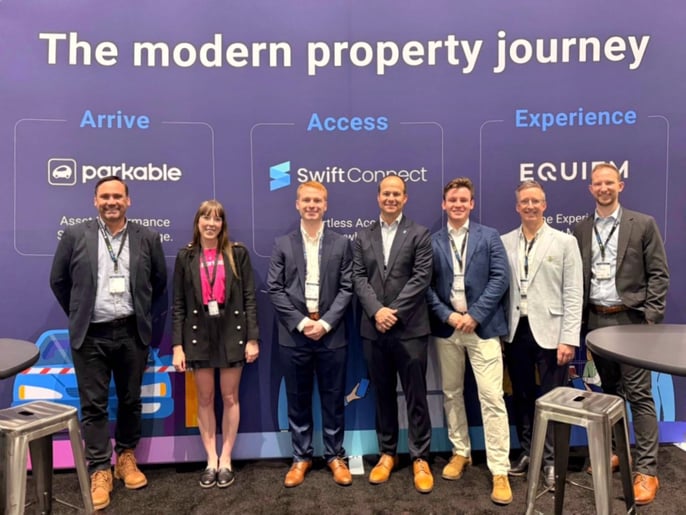
We were in San Diego earlier this month for Realcomm IBcon 2026, the annual gathering that sets the agenda for technology in commercial and corporate real estate. The 28th annual Realcomm IBcon wrapped in San Diego, with the conference organisers noting the energy at this year's event was stronger than ever. Having been to enough of these to know when the conversation is shifting, here's our honest take on what mattered.
The theme was accurate
This year's conference theme was "Tech REset: Now to Next - Focus. Adjust. Accelerate." That framing was more than just conference marketing. It reflected something real about where the industry is right now.
The proptech hype cycle of the last decade has mostly corrected. The technology hype cycle that began in 2008, fuelled by abundant, inexpensive capital, has come to a close, with significant impact on the trajectory of hundreds of PropTech start-ups. What's left is a more grounded conversation - one that's less interested in what technology could theoretically do, and more focused on what it's actually doing, in real buildings, right now.
That's a healthy shift. And the conference programme reflected it.
AI was everywhere. The hype wasn't.
The main stage set the tone early: not a debate about whether AI would change real estate, but how, specifically, and what that means for platforms, operators, and the asset managers who need to make sense of the output.
What was notable is how consistent the framing was across sessions: AI is not a product. It's a capability layer. And that capability is only as useful as the infrastructure it sits on.
A key observation from the conference floor was that the future of commercial real estate belongs to those who can turn operational complexity into actionable intelligence. That's not an AI-first argument. It's a data-first argument. The platforms that have spent years building real workflows and accumulating real data are the ones best placed to make AI work. Several sessions noted the widening gap between real innovation and AI hype, with practitioners drawing a clear line between AI that's solving actual problems in buildings today, and AI that's still a slide in a pitch deck.
Agentic AI started showing up in real conversations
A few years ago, the word "agent" in a CRE context meant a leasing agent. That's changing. Sessions on agentic AI explored a future where every workflow - leasing, maintenance, tenant management - is driven by intelligent agents capable of proactively handling lease renewals, predicting maintenance issues, and streamlining service requests.
The practical application that got the most attention was renewal risk. The idea that a system could surface a clear signal - this tenant's engagement has been trending down for six months, here's what that's historically preceded - and deliver it to a property manager with enough lead time to act, resonated across every conversation we had. It's not science fiction. The data to do it already exists in platforms like ours. The infrastructure to close the insight loop in real time is what's being built now.
The tenant experience conversation matured
If there was a positioning shift that was visible across multiple sessions, it was this: tenant experience is no longer a separate track from asset performance. Discussions on how commercial real estate owners and operators are leveraging technology to enhance building amenities - from access and personalised services to AI-driven concierge - consistently framed these as tools for driving retention and asset value, not just occupier satisfaction.
That framing matters. When engagement is treated as a retention lever, the business case for investing in it changes completely. The question stops being "how do we make tenants happy?" and becomes "how do we protect NOI?" Those are related questions, but they get very different levels of attention from asset managers.
What didn't change
Relationships. The conversations that happened in the hallways and at dinners were, as always, the most useful ones. CRE is still a relationship business, and no amount of automation changes that. What AI does is give the people in those relationships better information, so the conversations they have are better ones.
The property managers and asset managers who are going to benefit most from the next wave of technology aren't the ones who hand their decision-making to a machine. They're the ones who use better data to make better calls, faster, and spend the time they recover on the high-value human work that actually moves the needle.
Our take
Realcomm 2026 confirmed a few things we've been building toward. The industry is past the hype phase and into the implementation phase. The platforms with real data and real operational depth are pulling ahead. And the conversation about AI in CRE has shifted from "should we?" to "how do we do this well?"
We'll be sharing more on where we're taking EquiemOne on the AI and intelligence front in the coming months. If you want to talk about what any of this means for your portfolio, get in touch.

.jpg?width=461&height=400&name=Untitled%20presentation%20(1).jpg)
